
Partner links on this page
Every button below marked partner link leads to the advertiser through a tracking link. If you sign up or install after clicking it, Atom Agentura s.r.o. receives a commission from the advertiser. It costs you nothing extra and the price or offer you get is the same as going direct.
Commission does not buy coverage: the assessments, the criticism and the corrections on this site are written independently of the advertiser, as set out in our editorial policy. RAID: Shadow Legends is free to download and contains optional, chance-based in-app purchases.
What a shard is, in one paragraph #
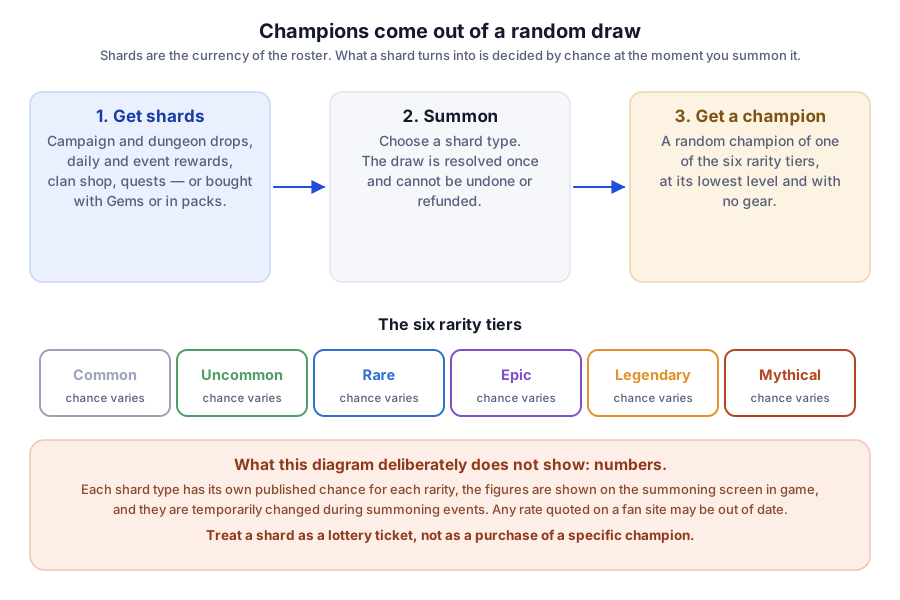
A shard is a summoning token. You consume it, the game resolves a random draw against published per-shard chances, and you receive one champion. The draw is resolved once, it cannot be undone, and you cannot choose the outcome. That is the whole mechanic, and it is the mechanic the rest of the game orbits.
The shard types and what they are for #
| Shard | Broadly what it is for |
|---|---|
| Mystery Shard | The most common. Weighted heavily towards the lowest rarities and mostly useful as upgrade fodder. |
| Ancient Shard | The bread-and-butter shard. Can produce higher rarities, but the chance is low and most pulls will not. |
| Void Shard | Draws only from the Void affinity pool, which is useful when you need champions that never suffer an affinity penalty. |
| Sacred Shard | The premium shard, with a materially better chance at the top rarities. Slow to earn without spending. |
| Primal Shard | Introduced later; draws from its own pool and is the route to the Mythical tier. Rare, and event-driven. |
Shards arrive from campaign and dungeon drops, daily and weekly missions, event rewards, the clan shop and quest milestones. They are also sold, directly for Gems or bundled into paid packs. There is no separate “free” and “paid” summon pool: a bought Ancient Shard behaves exactly like an earned one.
Rates: what we will and will not tell you #
We do not publish summoning percentages on this site. Three reasons: the published chance differs per shard type, it is temporarily changed during summoning events, and the authoritative figures are displayed on the summoning screen in the game itself. Any percentage you read on a fan page — including ours, if we printed one — can be silently out of date. Tap the information icon on the summon screen and read the current numbers there.
What we can say without a number: the chance of a top-rarity champion from a standard shard is low enough that you should plan your account around the champions you already have. Players who plan around a champion they intend to summon are the players who end up spending unplanned money.
Read the rates in the game itself
They are on the summoning screen, before you spend anything. The download is free.
Get RAID: Shadow Legendspartner linkPartner link. Atom Agentura s.r.o. earns a commission if you install through this link. It costs you nothing extra. The game is free to download and contains optional in-app purchases.
Fusions, events and the champions you cannot simply summon #
Not every champion is available from a shard at any time. Plarium runs Fusion events: multi-week collection tasks in which you assemble specific lesser champions, combine them in stages, and receive a specific champion at the end. Similar time-limited routes exist for certain event champions.
Two things follow. First, some champions have a closing window, and if you miss it you wait for a re-run that may not come. Second, and more importantly for how you read promotional copy: the claim that “every champion can be obtained through gameplay” is not supportable. Some can only be obtained during a window, and all of them, at some point, involve a random draw.
Mercy and progressive chance #
Plarium operates mechanics that improve your odds after repeated unsuccessful summons, and it documents progressive-chance behaviour for the events where it applies. The precise thresholds for ordinary shards are not, to our knowledge, published by the publisher; the numbers that circulate in the community are player-tracked estimates. We are not going to repeat them as fact.
The safe reading is: a long dry run is not literally endless, but you should not treat a community-tracked threshold as a promise, and you should certainly not buy shards to “reach” one.
Duplicates, fodder and what to do with a bad pull #
Most pulls will be champions you do not want. That is not a malfunction, it is the economy: low-rarity champions are the fuel for levelling and ranking up the champions you do want. Duplicates of good champions have their own uses — arena defence, faction-specific content, or as rank-up material.
Before you sacrifice anything, check whether it belongs to a faction you are short of. Faction Wars requires a bench of champions from each faction, and new players routinely feed away champions they need there six months later.
Five rules that will save you money #
- Read the published chances on the summon screen before you spend anything, every time — events change them.
- Never spend to chase a specific champion. The draw does not know what you want.
- Set a monthly limit before you open the shop, and treat it as fixed.
- Invest in what you pulled, not in what you hoped to pull. Gear matters more than rarity.
- Keep faction coverage in mind before feeding champions away.
Chance-based in-game purchases are designed to feel like the next attempt is the one that pays off. If that pattern has caused you difficulty before, use the purchase blocks your platform provides and do not rely on willpower alone. There is no shame in playing with purchases switched off at the operating-system level.
Read next
- Prices and purchasesWhat the shop sells, and for how much.
- Game systemsWhy gear beats rarity.
- Beginner guideWhat to do with your first shards.
Sources
- Plarium Global Ltd — RAID: Shadow Legends official site — https://raidshadowlegends.com/
- Plarium support centre — game mechanics and affinity articles — https://raid-support.plarium.com/
- Apple App Store listing — size, minimum iOS version, age rating, in-app purchase list — https://apps.apple.com/us/app/raid-shadow-legends/id1371565796
- Steam store listing — Windows requirements, release date, purchase labelling — https://store.steampowered.com/app/2333480/RAID_Shadow_Legends/
- Wikipedia — RAID: Shadow Legends (release history, reception, marketing controversy) — https://en.wikipedia.org/wiki/Raid:_Shadow_Legends
Store listings and support pages were consulted on 21 September 2026. Live game figures change with each update: where this page and the publisher’s own information diverge, the publisher’s information prevails.