
Partner links on this page
Every button below marked partner link leads to the advertiser through a tracking link. If you sign up or install after clicking it, Atom Agentura s.r.o. receives a commission from the advertiser. It costs you nothing extra and the price or offer you get is the same as going direct.
Commission does not buy coverage: the assessments, the criticism and the corrections on this site are written independently of the advertiser, as set out in our editorial policy. RAID: Shadow Legends is free to download and contains optional, chance-based in-app purchases.
The turn meter: why Speed is king #
RAID does not use a fixed turn order. Every combatant has a turn meter that fills continuously, at a rate set by its Speed stat. When a meter fills, that combatant acts and the meter resets to zero. Everything else in the combat system is built on top of this.
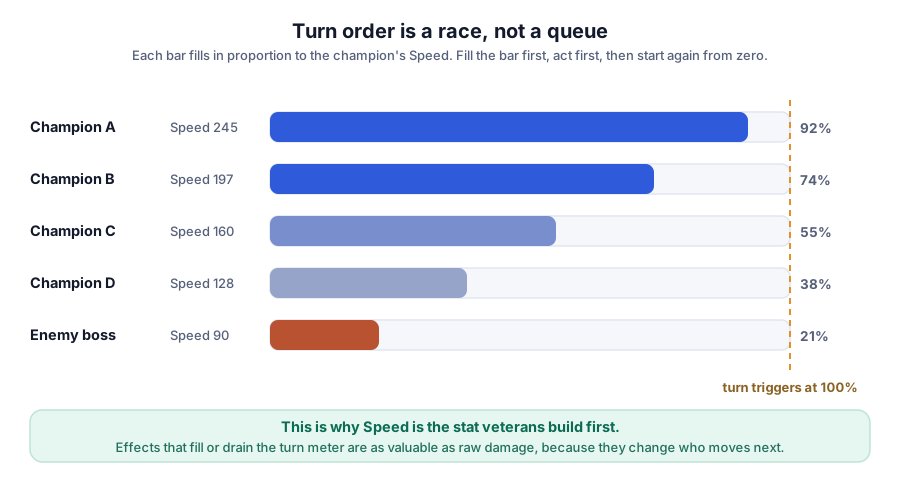
Two practical consequences. First, Speed is not a quality-of-life stat, it is a combat stat: more turns means more damage, more healing and more debuffs. Second, any skill that fills your own meter or drains an enemy’s is effectively a skill that steals turns, which is why champions with those abilities hold their value for years.
This is also the source of the genre habit known as speed tuning: building a team whose Speed values are deliberately spaced so that champions act in a fixed, repeatable order. It is fiddly, it involves arithmetic, and for a certain kind of player it is the best thing about the game.
Affinity: a three-way cycle plus a neutral #
Every champion and every enemy has exactly one affinity. Magic, Spirit and Force form a cycle: Force beats Magic, Magic beats Spirit, Spirit beats Force. Void is neutral — it has no strength and no weakness against the other three.
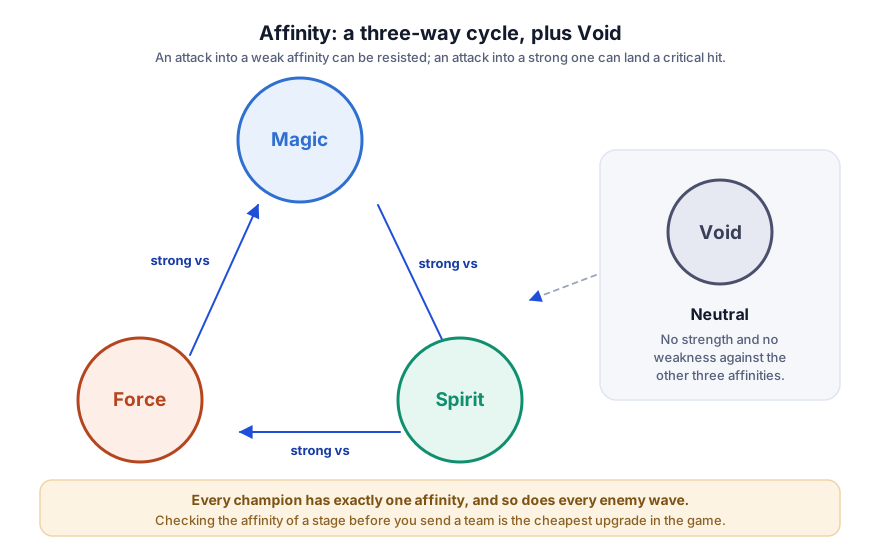
Because a stage’s enemies usually share an affinity, checking it before you commit a team costs nothing and changes outcomes. Void champions are valuable precisely because they never suffer the penalty, which makes them safe choices for content you have not scouted.
The stats, and what each one is for #
| Stat | What it does | When it matters most |
|---|---|---|
| Speed (SPD) | Fills the turn meter faster, so the champion acts more often. | Always. It is the most contested stat in the game. |
| Attack (ATK) | Scales damage on attack-based skills. | Damage dealers whose skills scale from attack. |
| Health (HP) | Total hit points; also scales some skills and damage formulas. | Tanks, and damage dealers whose skills scale from health. |
| Defence (DEF) | Reduces incoming damage; also scales certain skills. | Survivability against hard-hitting bosses. |
| Critical Rate (C. RATE) | Chance for a hit to be a critical hit. | Any damage dealer — usually pushed towards its cap first. |
| Critical Damage (C. DMG) | How much extra damage a critical hit does. | After critical rate is reliable; before that it does nothing useful. |
| Accuracy (ACC) | Decides whether your debuffs overcome enemy resistance. | Debuffers in dungeons and late-game content. |
| Resistance (RES) | Chance to block incoming debuffs. | Arena defence and content that stuns or freezes your team. |
Critical Damage is worthless without Critical Rate. Building a champion to high critical damage while its critical rate sits at a third means most hits do not benefit at all. Raise critical rate to something dependable first, then add damage.
Accuracy against resistance: the invisible dice roll #
Debuffs — lowering an enemy’s defence, stunning it, preventing it from healing — are the backbone of most successful teams, and they are not guaranteed to land. Whether a debuff sticks is decided by your Accuracy against the target’s Resistance. Enemy resistance rises sharply in higher dungeon levels and late-game content.
This is why a debuffer without Accuracy is a decoration. It is also the most common reason a team that clears stage nineteen of a dungeon falls apart on stage twenty: nothing about your damage changed, your debuffs simply stopped landing.
Try the systems in practice
The fastest way to understand turn order and affinity is twenty minutes in the campaign. The download is free.
Get RAID: Shadow Legendspartner linkPartner link. Atom Agentura s.r.o. earns a commission if you install through this link. It costs you nothing extra. The game is free to download and contains optional in-app purchases.
Skills, cooldowns and books #
Champions have two to four active skills, each with its own cooldown measured in turns, and some have passive abilities. Skill upgrades — applied with items commonly called books — reduce cooldowns or raise the chance of a skill effect. For some champions the difference between an unbooked and a fully booked kit is the difference between usable and excellent, which is worth knowing before you spend scarce books on the wrong target.
Levelling, ranking up and ascension #
Three separate upgrade tracks apply to every champion, and it is easy to confuse them:
- Level — raised by feeding other champions as experience fodder, or by running campaign stages.
- Rank — raised by sacrificing other champions, which raises the level ceiling and base stats.
- Ascension — consumes elemental potions farmed from specific content and unlocks the later skills in a champion’s kit.
The practical point: a champion is not “finished” at maximum level. Rank, ascension, skill books, gear and masteries are all separate investments, and a half-invested Legendary is usually weaker than a fully invested Rare.
Masteries #
Each champion has a mastery tree with three branches — offensive, defensive and support — unlocked with a resource earned by battling. Mastery choices are meaningful: some nodes add flat damage, others add sustain, and a few change how a champion plays entirely. Because the resource is slow to earn, pick the champions you are confident about before spending it.
Gear and set bonuses #
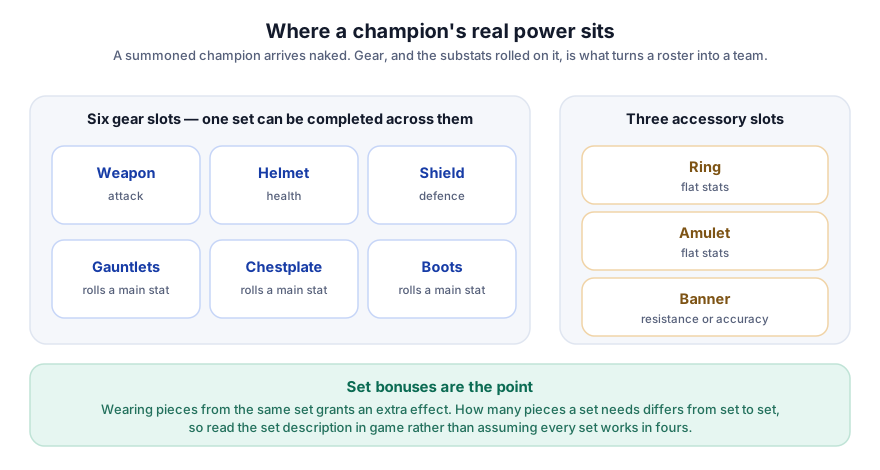
Gauntlets, chestplate and boots roll a main stat, which is the single most important property of a piece: boots with Speed as the main stat are worth more than almost any substat combination elsewhere. Upgrading a piece re-rolls its substats, which is where the game’s deepest resource sink lives.
What to prioritise, in order #
- Speed on boots, and Speed substats wherever you can get them.
- Reliable critical rate on damage dealers before critical damage.
- Accuracy on debuffers before anything else on them.
- Enough survivability to finish the fight — not more.
- Full investment in a few champions rather than partial investment in many.
Every mechanic above is described in the game’s own help screens and in Plarium’s support centre. Where our description and the publisher’s differ, the publisher’s is authoritative — game systems are rebalanced regularly.
Put it to work
Free download on mobile, Windows and Mac.
Get RAID: Shadow Legendspartner linkPartner link. Atom Agentura s.r.o. earns a commission if you install through this link. It costs you nothing extra. The game is free to download and contains optional in-app purchases.
Read next
- Summoning and shardsWhere champions come from, and the odds.
- Beginner guideA realistic first month.
- The main guideThe full picture, including monetisation.
Sources
- Plarium Global Ltd — RAID: Shadow Legends official site — https://raidshadowlegends.com/
- Plarium support centre — game mechanics and affinity articles — https://raid-support.plarium.com/
- Apple App Store listing — size, minimum iOS version, age rating, in-app purchase list — https://apps.apple.com/us/app/raid-shadow-legends/id1371565796
- Steam store listing — Windows requirements, release date, purchase labelling — https://store.steampowered.com/app/2333480/RAID_Shadow_Legends/
- Wikipedia — RAID: Shadow Legends (release history, reception, marketing controversy) — https://en.wikipedia.org/wiki/Raid:_Shadow_Legends
Store listings and support pages were consulted on 21 September 2026. Live game figures change with each update: where this page and the publisher’s own information diverge, the publisher’s information prevails.