
Partner links on this page
Every button below marked partner link leads to the advertiser through a tracking link. If you sign up or install after clicking it, Atom Agentura s.r.o. receives a commission from the advertiser. It costs you nothing extra and the price or offer you get is the same as going direct.
Commission does not buy coverage: the assessments, the criticism and the corrections on this site are written independently of the advertiser, as set out in our editorial policy. RAID: Shadow Legends is free to download and contains optional, chance-based in-app purchases.
What RAID: Shadow Legends is #
RAID: Shadow Legends is a free-to-play, turn-based collection role-playing game published by Plarium Global Ltd. You assemble teams of five champions, send them into scripted battles, and spend the rewards on making those champions stronger so that you can beat harder battles. It launched on mobile on 4 July 2018, gained a desktop client on 21 January 2020, and arrived on Steam on 9 January 2024.
That is the whole shape of it, and it is worth saying plainly because the game is better known for its advertising than for its design. If you have heard of RAID at all, you probably heard about it in the middle of a video you were trying to watch. The marketing became a running joke; the game underneath is a competent, extremely deep, and unambiguously monetised gacha RPG.
“Gacha” is the part that matters most, and the part most promotional pages skate over. Champions are not bought, unlocked or chosen. They come out of randomised draws called Shards. You can earn Shards by playing, and you can buy them with in-game currency that you can buy with money. Both routes end at the same random draw.
- Turn-based, not real time
- Teams of five
- Random champion summons
- Free to download
- Optional in-app purchases
- Mobile, Windows and Mac
- 13+ on store listings
Download it and see for yourself
Free on iOS, Android, Windows and Mac. No purchase needed to play through the campaign.
Get RAID: Shadow Legendspartner linkPartner link. Atom Agentura s.r.o. earns a commission if you install through this link. It costs you nothing extra. The game is free to download and contains optional in-app purchases.
Corrections we made to this page #
An earlier version of this page described RAID: Shadow Legends as a game with “no loot boxes or pay-to-win mechanics” in which “every champion can be obtained through gameplay” and which “does not sell power”. That was wrong, and we have removed it. RAID is a gacha game: champions come from randomised Shard summons, and the platform holders themselves label its in-app purchases as chance-based. It also claimed the game had “over 200 champions”, which is years out of date, and it was framed as a “reader-submitted story”, which it never was.
This page is an advertising-funded editorial article written by a named editor. The full list of what changed and why is in our corrections procedure.
How a battle actually works #
Battles are turn-based and mostly automatic once you understand them, but the underlying system is not a simple left-to-right turn queue. Every champion and every enemy has a hidden turn meter that fills continuously. The rate it fills at is set by the champion’s Speed stat. Whoever fills their meter first acts, the meter resets, and the race starts again.
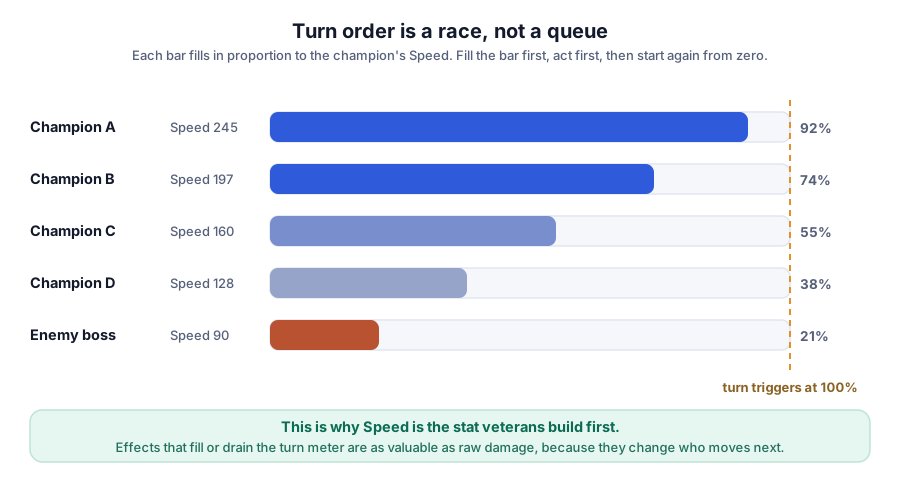
This has a consequence that takes new players a while to notice: a team of fast, well-coordinated champions can effectively deny the enemy its turns. Much of the high-end play in RAID is about controlling turn order rather than raising damage numbers, and a large part of the game’s theorycrafting community exists to work out Speed thresholds for specific bosses.
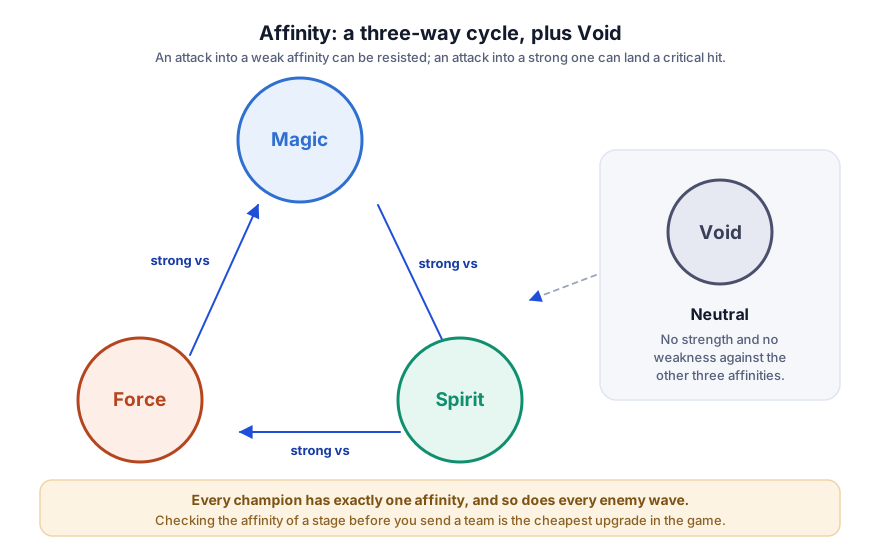
The second layer is affinity. Each champion belongs to one of four affinities: Magic, Spirit, Force or Void. The first three form a cycle — Force is strong against Magic, Magic is strong against Spirit, and Spirit is strong against Force. Void sits outside the cycle with no strengths and no weaknesses. Attacking into an affinity you are weak against can have your hit resisted outright; attacking into one you are strong against can turn a hit into a critical one.
On top of those two systems sit skills with cooldowns, a long list of buffs and debuffs, a stat called Accuracy that decides whether your debuffs land against an enemy’s Resistance, and a mastery tree per champion. None of it is hidden from you, but very little of it is explained in the tutorial, which is the main reason the genre has such a large ecosystem of third-party guides.
The roster and the rarity tiers #
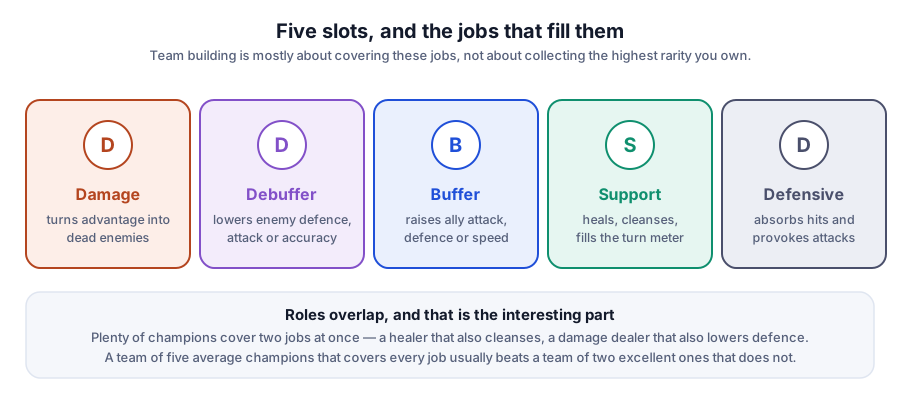
Champions come in six rarity tiers: Common, Uncommon, Rare, Epic, Legendary and Mythical. Higher rarity generally means higher base stats and a better skill kit, and it also means a longer and more expensive upgrade path.
How large is the roster? Larger than most promotional copy suggests. Community champion databases put the total somewhere around a thousand champions in 2026, with new ones added in most content updates. We are deliberately not quoting a precise number here: the only authoritative count is the in-game champion index, and it changes every few weeks. Any fixed figure on a fan page — including the “over 200” this page used to claim — is wrong within months.
A roster that size is the point of the game and also its trap. It means there is always a better champion for a job than the one you have, which is exactly the condition that makes a random summon feel necessary. Plan around the champions you own, not the ones you are chasing.
How you actually get champions #
You get champions by summoning Shards. There are several Shard types, they are earned from campaign drops, dungeons, daily and event rewards, quests and clan activity, and they can also be bought with Gems or inside paid packs. Each type has its own published chance of producing each rarity, shown on the summoning screen in game, and those chances are temporarily improved during summoning events.
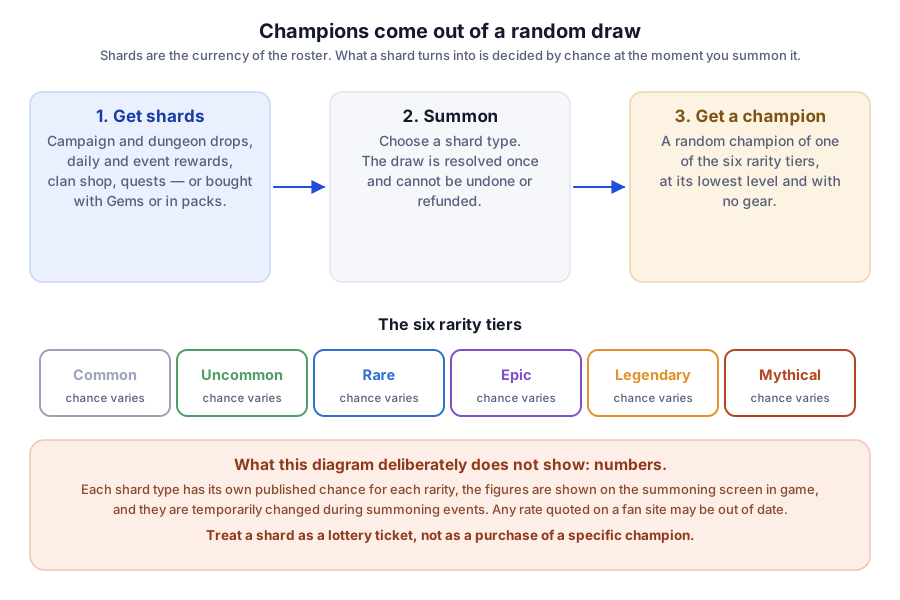
Two things follow from this, and they are the two things a new player most needs to internalise. First, you cannot buy a specific champion. Money buys attempts, not outcomes. Second, some champions are only obtainable during specific events or through Fusion — multi-week collection tasks that combine lesser champions into a specific one — and those windows close. “Every champion is obtainable by playing” is not a claim anyone can support, and we no longer make it.
Plarium does operate progressive-chance and mercy mechanics on some Shard types, so that a long run of bad luck improves your odds. The thresholds are documented in the publisher’s support material for the events it applies to; community trackers circulate numbers that Plarium has not confirmed. Treat those with caution.
Want to try the summoning loop yourself?
It costs nothing to download and play. Read our summoning explainer first if you want to know what you are looking at.
Get RAID: Shadow Legendspartner linkPartner link. Atom Agentura s.r.o. earns a commission if you install through this link. It costs you nothing extra. The game is free to download and contains optional in-app purchases.
Gear is where the real power curve lives #
A newly summoned champion arrives at level one with no equipment. Gear is what turns a roster into a team: six gear slots, three accessory slots, sets that grant an extra effect when you wear enough matching pieces, and randomised substats on each piece that are re-rolled when you upgrade it.
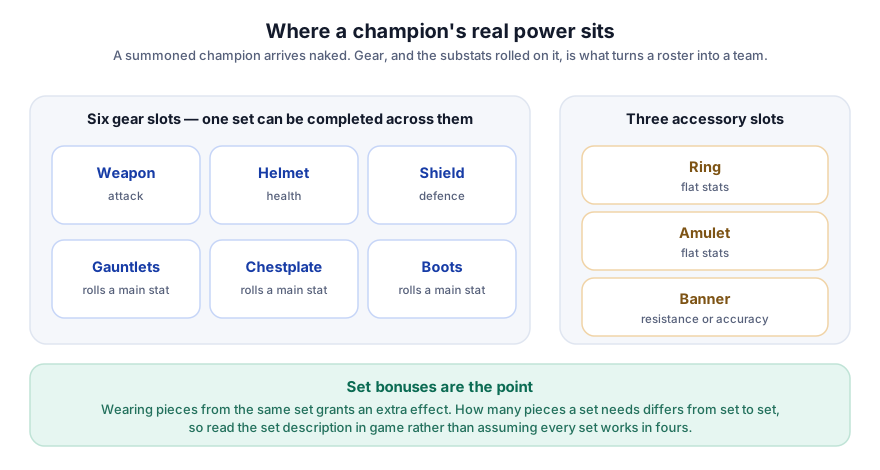
The consequence is that the grind in RAID is mostly a gear grind, not a champion grind. Late-game players farm dungeons for weeks to build one properly geared champion, and a well-geared Rare champion routinely outperforms a badly geared Legendary. This is genuinely the most encouraging fact about the game for a player who does not want to spend money — and it is also the part that takes the most time.
What there is to do #
The activities are separated by the resource they pay out, and that is the most useful way to think about them. You are almost never short of “content”; you are short of one specific resource, and there is a mode that produces it.
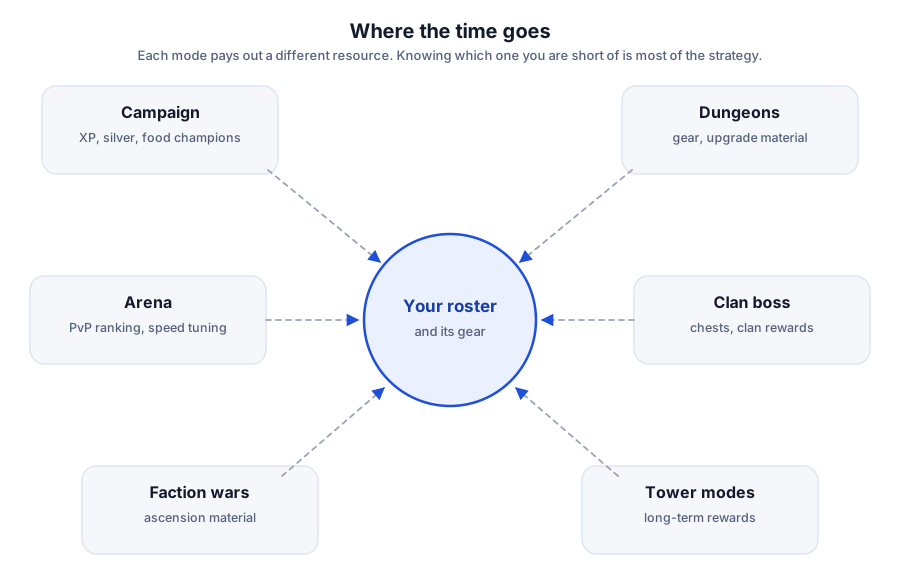
Campaign
Twelve chapters, each with stages across four difficulty levels. The reliable source of experience, silver and the low-rarity champions used as upgrade fodder.
Dungeons
Repeatable bosses that drop gear and the materials needed to ascend champions and level skills. This is where most account time eventually goes.
Arena
Asynchronous player-versus-player against other accounts’ defence teams. Heavily Speed-driven, and the mode where the gap between spending and non-spending accounts shows most clearly.
Clan boss and siege
Co-operative and competitive clan content. Joining an active clan early is the single best free upgrade to your reward rate.
Faction wars
Requires a deep bench within each faction, and pays the material used to ascend champions. A long-term goal, not an early one.
Tower modes
Rotating, escalating floors with scripted mechanics, aimed at established accounts and paying out long-term rewards.
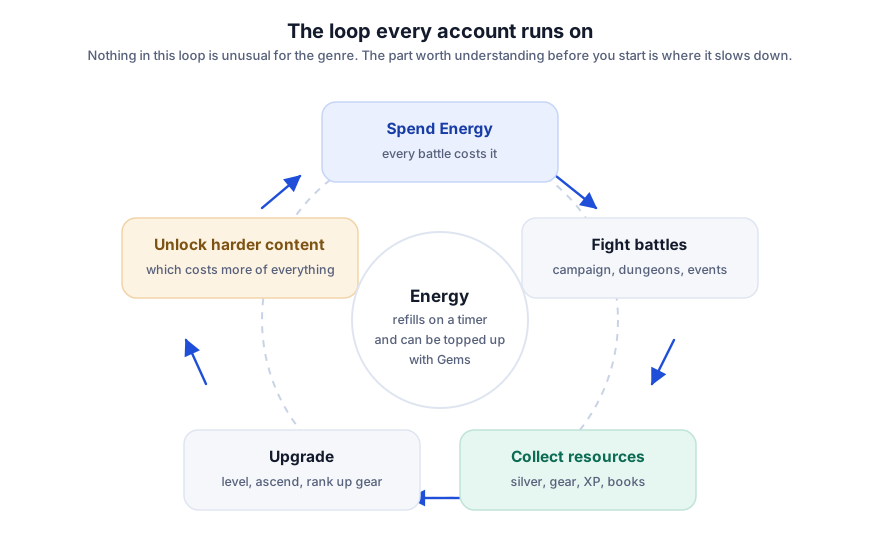
All of it is gated by Energy, which refills on a timer and can be topped up with Gems. Energy, not difficulty, is what sets the pace of a free account.
Money: the honest version #
RAID is free to download and free to play, and you can finish a great deal of content without paying. That is true. It is also true that it is monetised hard, and that the store sells the two things the loop is short of: summoning attempts and time.
On the Apple App Store listing, individual in-app purchases run from about $0.99 for a starter pack up to $99.99 for the largest bundle, with subscription “cards” between roughly $9.99 and $49.99 a month. Steam labels the game’s purchases as including chance-based in-game purchases — the platform’s own wording for a gacha.
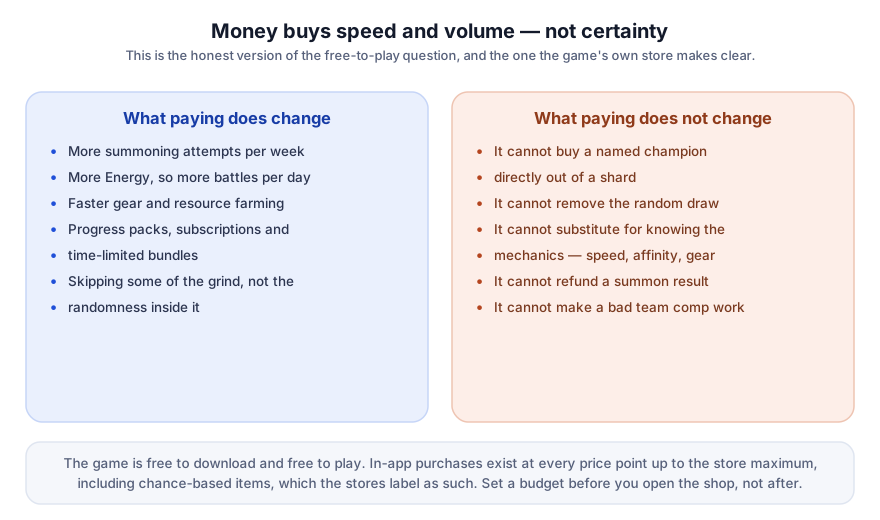
Decide what, if anything, you are willing to spend per month before you open the in-game shop, and treat the number as fixed. Chance-based purchases are designed to make the next attempt feel like the one that will work. If spending in a game has ever been a problem for you, or if the account belongs to a teenager, use the purchase controls your platform already provides — Screen Time on iOS, parental controls on Google Play, Family View on Steam.
Our prices and purchases page breaks the store down in more detail, including what the subscription cards actually provide.
Reception and criticism — including the awkward parts #
A guide that only lists advantages is an advertisement, so here is the other side, sourced rather than invented.
The game’s monetisation has been sharply criticised in the games press. TheGamer has described it as “the epitome of pay to win”, and Gamezebo’s review noted that progress becomes difficult if you do not intend to spend money on upgrades. We disagree with the strongest version of that claim — a patient free player can clear a lot of content, and gear quality matters more than rarity — but anyone telling you that spending confers no advantage in Arena is not being straight with you.
The advertising has its own history. RAID’s sponsorship campaign across YouTube and Twitch was so pervasive that it became an internet meme, and in February 2020 Plarium faced public criticism over influencer sponsorships that were not disclosed to the standard US regulators expect. We mention it because this page is itself funded by a commercial link, and you are entitled to know that the advertising around this game has previously been criticised for exactly the disclosure failure we try to avoid: every commercial link here is labelled “partner link” and carries a commission notice.
On the positive side, the game has been maintained and expanded continuously for over eight years, is translated into more than a dozen languages, and runs on a wide range of hardware. For a live-service title, longevity of that kind is a real signal.
Who it suits, and who should skip it #
Worth trying if…
- You like optimisation problems and spreadsheets more than reflexes.
- You want a game you can dip into for twenty minutes a day for months.
- You are comfortable with slow progress and are content to ignore the shop.
- You enjoy team-building puzzles with hard constraints.
Probably not for you if…
- Random rewards are unsatisfying or stressful for you.
- You want to reach competitive parity quickly without spending.
- You dislike energy timers and daily-login structures.
- You are looking for a story-driven RPG — the narrative is thin.
Verdict #
RAID: Shadow Legends is one of the deepest turn-based collection RPGs on mobile, and one of the most aggressively monetised. Both halves of that sentence are true at once, and any guide that gives you only one of them is selling you something.
If the appeal of a game is fitting mechanical pieces together — speed tuning, debuff accuracy, set bonuses, affinity coverage — there is more to chew on here than in almost anything else in the genre, and you can do it without paying. If you need to feel competitive quickly, or if random rewards get under your skin, this is not the game to start with, and no amount of partner commission will make us say otherwise.
Free to download, genuinely playable without spending, and honest about the fact that the shop is always there.
Ready to start?
Download is free on all platforms. Our beginner guide covers the first thirty days.
Get RAID: Shadow Legendspartner linkPartner link. Atom Agentura s.r.o. earns a commission if you install through this link. It costs you nothing extra. The game is free to download and contains optional in-app purchases.
Read next
- Game systems in depthTurn meter, affinity, stats, masteries and what each one really does.
- Summoning and shardsThe gacha layer explained without the marketing language.
- Beginner guideA realistic first month: what to build, what to ignore.
- Prices and purchasesWhat the shop sells, what it costs and what it does not fix.
- Platforms and requirementsPublished system requirements for mobile, Windows and Mac.
- Frequently asked questionsShort, sourced answers to the questions we get asked most.
Sources
- Plarium Global Ltd — RAID: Shadow Legends official site — https://raidshadowlegends.com/
- Plarium support centre — game mechanics and affinity articles — https://raid-support.plarium.com/
- Apple App Store listing — size, minimum iOS version, age rating, in-app purchase list — https://apps.apple.com/us/app/raid-shadow-legends/id1371565796
- Steam store listing — Windows requirements, release date, purchase labelling — https://store.steampowered.com/app/2333480/RAID_Shadow_Legends/
- Wikipedia — RAID: Shadow Legends (release history, reception, marketing controversy) — https://en.wikipedia.org/wiki/Raid:_Shadow_Legends
Store listings and support pages were consulted on 21 September 2026. Live game figures change with each update: where this page and the publisher’s own information diverge, the publisher’s information prevails.